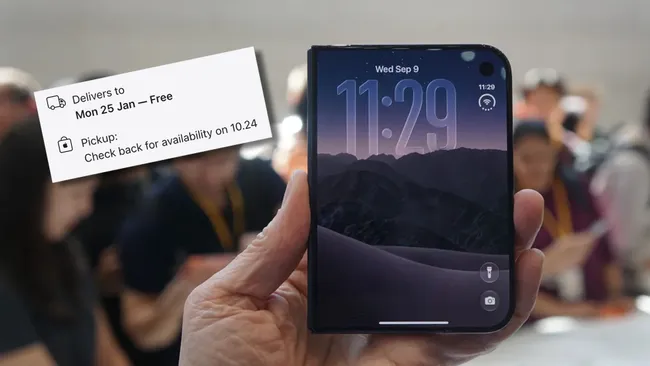
For a product that has been rumoured for years, Apple’s first major foldable iPhone was always going to attract enormous attention. Now, however, the excitement is being tempered by an increasingly familiar message for prospective buyers: iPhone Duo shipping estimates may have slipped into 2027.
That is quite a change for a device expected to represent one of Apple’s biggest design shifts in years. The iPhone Duo foldable is tipped to combine the familiar iPhone experience with a large internal display, a slim outer profile and a premium design aimed squarely at the growing foldable-phone market.
For UK buyers who have been waiting for Apple to finally enter the category, the delay could be frustrating. But it may also give Apple more time to solve the problems that have made foldable phones difficult to perfect.
Why the iPhone Duo matters so much
Apple has watched Samsung, Google, Motorola and other manufacturers experiment with foldable phones while continuing to rely on the traditional iPhone design.
That strategy has worked remarkably well. Yet the smartphone market is changing. Consumers are increasingly asking whether a new phone offers something genuinely different rather than simply delivering a faster processor or another camera upgrade.
This is where the Apple foldable iPhone could become particularly interesting.
The iPhone Duo is expected to open like a book, providing a much larger screen when required while remaining relatively compact when folded. In practical terms, that could mean carrying something approaching a small tablet without actually carrying two separate devices.
For commuters on Britain’s trains, frequent travellers and people who use their phone for work, that flexibility could be more meaningful than another incremental camera improvement.
A bigger screen without carrying a tablet
The most obvious attraction is the display.
A conventional smartphone is excellent for messaging, maps, social media and quick browsing, but there are situations where the screen simply feels too small. Reading documents, editing photographs, watching films or working with multiple apps can become much easier on a larger panel.
A well-designed foldable iPhone with a large inner display could offer the best of both worlds.
Fold it shut and it behaves like a normal smartphone. Open it and the experience becomes much closer to a compact tablet.
That versatility is one of the biggest reasons foldables continue to attract attention despite their premium prices.
Apple’s real challenge is durability
However, Apple cannot simply make a phone that folds. It has to make one that people trust to keep folding for years.
The hinge and flexible display are obvious engineering challenges, but durability goes much further. Buyers will want reassurance about screen creases, dust, accidental drops, water resistance and long-term reliability.
This is particularly important in Britain, where phones are routinely exposed to rain, cold weather and the occasional unfortunate encounter with a pavement.
For that reason, iPhone Duo durability could become just as important as its display technology.
Apple has built its reputation around tightly integrated hardware and software, so consumers will expect the foldable experience to feel polished rather than experimental.
Battery life could be another deciding factor
There is another question that British buyers are likely to ask: how long will the battery last?
A foldable phone has more screen real estate to power, while its slim design can make battery capacity and thermal management more complicated.
That makes iPhone Duo battery life a particularly important part of the story.
If Apple manages to combine efficient hardware with intelligent power management, the larger display could become genuinely useful without forcing users to reach for a charger halfway through the day.
For people who spend hours travelling, navigating London, watching video or using mobile data, dependable battery life may ultimately matter more than having the thinnest possible hinge.
The 2027 delay could actually be good news
At first glance, a 2027 shipping estimate sounds like bad news. Nobody likes waiting longer for a product they have already decided to buy.
But there is a strong argument that Apple should take its time.
The foldable-phone category is still evolving. Manufacturers have become much better at making thinner hinges, reducing display creases and improving durability, but compromises remain.
Apple entering the market later could allow it to learn from the mistakes of earlier foldables.
Instead of being first, Apple could aim to be the company that makes the technology feel mature.
That distinction could be crucial for the first foldable iPhone. Apple does not necessarily need to invent every component from scratch. It needs to make the overall experience convincing enough that a conventional iPhone owner sees a reason to switch.
Britain’s foldable market is getting harder to ignore
The UK smartphone market has already become familiar with premium foldables. Samsung’s Galaxy Z Fold and Z Flip families have helped make the form factor more mainstream, while Motorola and other brands have pushed the idea of folding phones into different price categories.
That creates an interesting situation for Apple.
By the time the iPhone Duo arrives, British consumers may no longer regard foldables as futuristic gadgets. They may simply expect Apple to offer one.
The question will then become whether Apple’s version provides enough advantages to justify its likely premium price.
Will the iPhone Duo replace the Pro Max?
Probably not for everyone.
The traditional Pro Max formula still appeals to people who want a large display, excellent cameras and long battery life without the additional complexity of a hinge.
The iPhone Duo versus iPhone Pro Max decision could therefore come down to priorities.
If photography, durability and simplicity matter most, a conventional flagship may remain the safer option. If multitasking, reading, entertainment and having a tablet-sized display in your pocket are more important, the foldable could be much more compelling.
The foldable will also need to prove that its extra flexibility is something people will actually use rather than simply admire for the first few weeks.
The bigger question: is Apple changing the iPhone formula?
Perhaps the most interesting part of the iPhone Duo story is not the delay itself.
It is what the device represents.
For years, smartphone innovation has largely centred on better cameras, faster chips, brighter screens and increasingly sophisticated software. Foldables introduce a different kind of innovation: changing the physical shape of the device.
If Apple gets the formula right, the Apple iPhone Duo 2027 could become more than another premium smartphone. It could signal a new direction for the iPhone family.
That makes the wait particularly interesting.
A delayed product is not necessarily a failed product. In Apple’s case, the extra time could be used to refine the hinge, improve foldable phone battery life, strengthen the flexible display and make iOS feel genuinely designed for two screen sizes.
For impatient buyers, 2027 may feel a long way away. But if the result is a foldable iPhone that feels as dependable as today’s best conventional models, the wait could ultimately make sense.
After all, the real goal isn’t simply to make an iPhone that folds.
It is to make a foldable iPhone that people no longer want to unfold any other way.
Apple Cell Phone Batteries – Shop a wide selection of Apple Cell Phone Batteries at www.oriccabattery.co.uk Fast Shipping. 30 Day Replacement Guarantee.